EEG-fMRI - Finger-tapping experiment
Author: Hadi Zaatiti <hadi.zaatiti@nyu.edu>
Description
In this experiment, the participant will tap each finger in a random order for 20 seconds continuously. The participant is asked by a text message to tap and then stop. As an EEG-fMRI experiment, it is important that the action is not repeated continuously during the block, otherwise we would not get clean EEG ERPs. If we are doing frequency analysis of the EEG data, then it is possible to repeat continuously the action throughout the block duration. This is repeated 3 times per finger, so a total of 15 blocks.
The experiment is coded in PsychToolBox.
main.m main file to run for experiment
- loadParameters.m defines the parameters for the experiment
- your radiographer needs to be aware of this duration
the block duration is 20 seconds,
the number of blocks are 15 blocks
maxRandWaitTime, this is the interblock random time duration necessary for any EEG-fMRI experiment
tapduration is set to 1.2 seconds
pauseduration is 0.8 seconds
one run is therefore 15 blocks * 20 seconds = 300 seconds
each finger is represented by 3 blocks per run
The acquired data for this experiment is 3 runs, therefore each finger was acquired for 9 blocks
- the condition for the fingers are numbered as
1 Thumb
2 Index
3 Middle
4 Ring
5 Pinkie
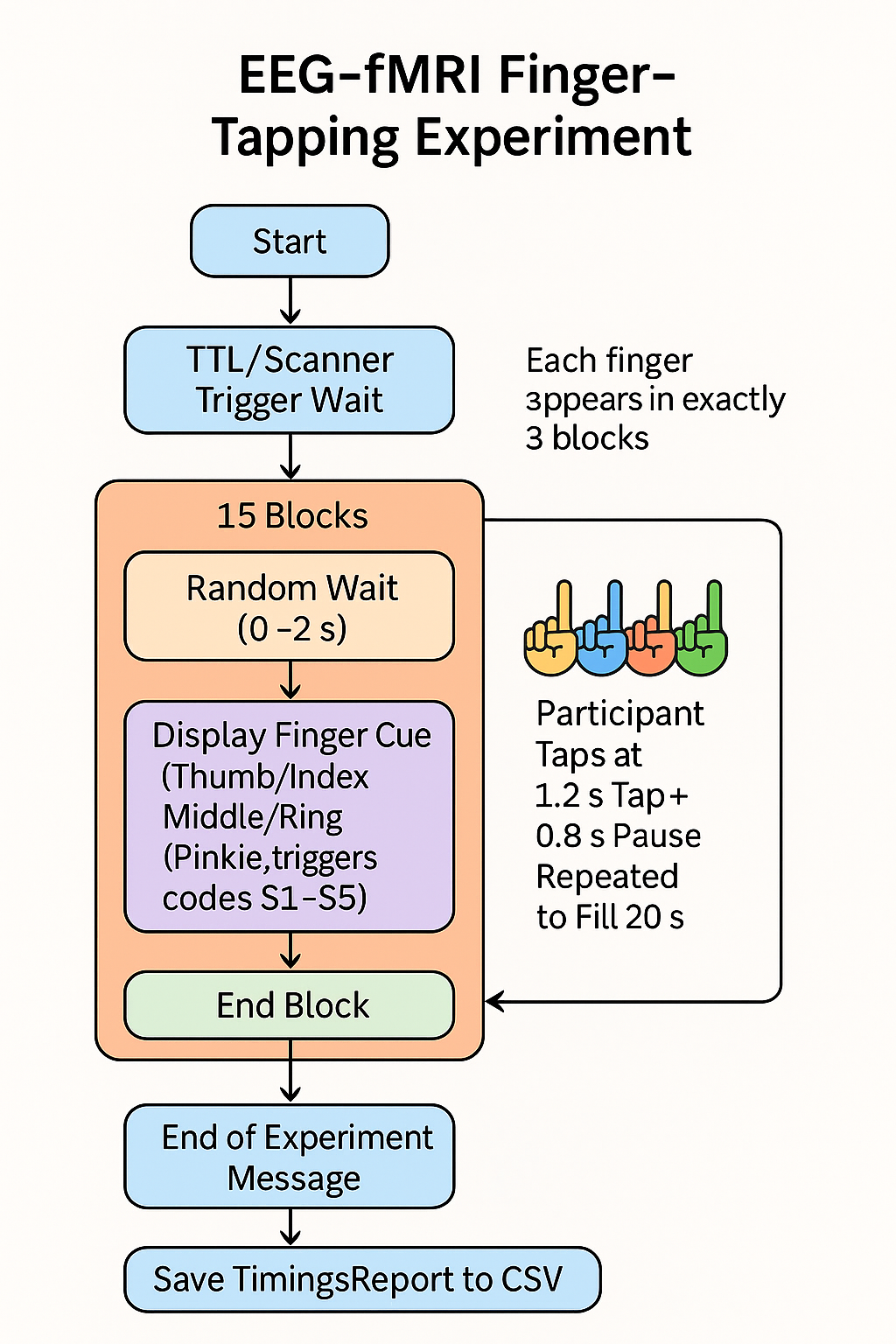
Finger tapping experiment diagram
Code access
Full directory
Snapshot of main file to run
Finger Tapping task code
% EEG-FMRI experiment for finger tapping
% fingertapping: tap each finger in an random order
% Author: Hadi Zaatiti <hadi.zaatiti@nyu.edu>

% Trigger code used:

% S1 marker, vpixx code = 2^4, used for thumb
% S2 marker, vpixx code = 2^6, used for index
% S3 marker, vpixx code = 2^8, used for middle
% S4 marker, vpixx code = 2^10, used for ring
% S5 marker, vpixx code = 2^12, used for pinkie


% Latest modifications:
% Check that each block is having a trigger signal
% Change the tapping to allow for EEG trial segments: each finger must be
% tapped once, the trigger signal corresponds to:
% - the time we asked the person to tap
% - the tapping itself? recorded from a button press?
% - the definition of the block should be investigated, is each block one
% finger being tapped, or multiple tappings while having a trigger for each
% tap?


% Checklist before running actual subject:
% - ensure directory of subject is empty if debugging data has been saved
% - ensure that isDemo is off in the parameters
% - ensure that useVpixx is on
% - ensure that the number of blocks is 25
% - ensure that the block duration is 20 seconds


% Checks and tests:
% - Trigger Check test each finger marker is appearing correctly
% - Check that block duration is good even with the random delay added
% - user-experience feedback on each tap
% - trials averaging on a test run

% TODO list:
% - add to the saving, the IBM and random time of each block


%
% startTime =
% totalTime =
%
% while totalTime < 20
%
%
%     for ii = 1:nFrames
%
%     flip
%
%     totalTime = getSecs - startTime;
%
%     end
%
% end


clear all
close all

global parameters;
global screen;
global tc;
global isTerminationKeyPressed;
global resReport;
global totalTime;

% datapixx = 1 means w're actually listening for the scanner to send us a
% trigger
% datapixx = 0 means w're in demo mode
global datapixx;


%% Setup screen

Screen('Preference', 'SkipSyncTests', 1);
Screen('Preference', 'Verbosity', 0);

timingsReport = {};

clear map
map = struct('block',0,...
    'startTime',0,...
    'endTime',0,...
    'totalBlockDuration',0);

timingsReport=cell2mat(timingsReport);
addpath('supportFiles');

%   Load parameters
%--------------------------------------------------------------------------------------------------------------------------------------%
loadParameters();


%   Initialize the subject info
%--------------------------------------------------------------------------------------------------------------------------------------%
initSubjectInfo();

% %  Hide Mouse Cursor

if parameters.hideCursor
    HideCursor()
end

%   Initialize screen
%--------------------------------------------------------------------------------------------------------------------------------------%


initScreen(); %change transparency of screen from here

%   Convert values from visual degrees to pixels
%--------------------------------------------------------------------------------------------------------------------------------------%
visDegrees2Pix();

%   Initialize Datapixx
%-------------------------------------------------------------------------- ------------------------------------------------------------%

if parameters.useVpixx
    % datapixx init
    AssertOpenGL;   % We use PTB-3;
    isReady =  Datapixx('Open');
    Datapixx('StopAllSchedules');
    Datapixx('RegWrRd');    % Synchronize DATAPixx registers to local register cache
end


%% Experiment design notes:

% have 25 blocks,  5 blocks for each finger
% pseudo-randomly permute the blocks by:
% ensuring we are getting all the possible sequences of fingers


%%
%  run the experiment
%--------------------------------------------------------------------------------------------------------------------------------------%
%

% % %To suspend the output of keyboard to command line
ListenChar(2);
%
%  init start of experiment procedures
%--------------------------------------------------------------------------------------------------------------------------------------%
%
 %  init scanner
%--------------------------------------------------------------------------------------------------------------------------------------%
%
if parameters.isDemoMode
    showTTLWindow_1();
else
    showTTLWindow_2();
end

%  iterate over all blocks
%--------------------------------------------------------------------------------------------------------------------------------------%
%
timing.soeDuration = 0;
isTerminationKeyPressed = false;

tic
for   tc =  1 : parameters.numberOfBlocks

    % A random wait time is required at the start of each block in an
    % EEG/fMRI experiment so that the gradient artifact correction do not
    % delete the relevant ERP


    disp(['Block number', tc]);
    block_type = parameters.blocktype(tc)

    switch block_type
        case 1

            blockText = parameters.blockOneMsg;
            trigger_code = parameters.blockOneTrig;

        case 2

            blockText = parameters.blockTwoMsg;
            trigger_code = parameters.blockTwoTrig;

        case 3

            blockText = parameters.blockThreeMsg;
            trigger_code = parameters.blockThreeTrig;
        case 4

            blockText = parameters.blockFourMsg;
            trigger_code = parameters.blockFourTrig;

        case 5

            blockText = parameters.blockFiveMsg;
            trigger_code = parameters.blockFiveTrig;

    end


    [blockStartTime, blockEndTime, interBlockRandomWaitduration] = showBlockWindowtest(blockText, trigger_code);

    disp(['End of block', tc]);

    %% Putti says: if we are moving the right hand, this means the right hemisphere is not being used
    % in this case, we can use all the signals from the right hemisphere as a baseline
    % According to the paper https://pmc.ncbi.nlm.nih.gov/articles/PMC3713710/pdf/HBM-33-1594.pdf
    % it is best to have a random permutation of the finger order to get a better spatial accuracy
    % according to Putti: we should correct for the MRI artifact (causing higher signal amplitudes with time) that has an upward trend with time (this is done by adding a linear drift vector at the end of the design matrix)
    % Add a first vector of constant values in order to take the average of the BOLD signals from all fingers as a baseline
    % In the paper the block duration is 3 seconds, however we can then take 12 seconds per finger

    % For the phase-encoding is basically fitting a since wave into the HRF
    % (the stimulus can be a small-time one like a pulse stimulus for a frame,
    % or a longer in time stimulus, (in this case the sequence of the fingers
    % should be the same all the time and not random), all voxels will have a
    % different shift but the average will be the same


    timingsReport(:,tc).trial = tc;
    timingsReport(:,tc).startTime =  blockStartTime;
    timingsReport(:,tc).endTime =  blockEndTime;
    timingsReport(:,tc).totalBlockDuration = blockEndTime - blockStartTime;
    timingsReport(:,tc).blocktype = block_type;
    timingsReport(:,tc).interBlockRandomWaitduration = interBlockRandomWaitduration;


end
%  init end of experiment procedures
%--------------------------------------------------------------------------------------------------------------------------------------%
%
startEoeTime = showEoeWindow();

%
%  save the data
%--------------------------------------------------------------------------------------------------------------------------------------%
%


writetable(struct2table(timingsReport),parameters.datafile);


%   To allow the output of keyboard to command line
%ListenChar(1);

% Show cursor back
ShowCursor('Arrow');

sca;

if parameters.useVpixx
    % datapixx shutdown
    Datapixx('RegWrRd');
    Datapixx('StopAllSchedules');
    Datapixx('Close');
end


%% What do we need to save?

% We need the stimulus finger sequence
% The ID of the subject
% Beginning and end of each block
Data access
EEG
Acquired datasets are stored safely on NYU Box under resting-state.
fMRI data
fMRI data is hosted on XNAT
Link to MRI data (Access given after requesting and upon eligibility)
https://xnat.abudhabi.nyu.edu/#/login Contact the xnat administrator admin.nyuad.xnat@nyu.edu
Analysis results
A generic pipeline is being built and documented here:
Generic pipeline for EEG-fMRI processing: Example on fingertapping experiment